
TECH
Doubao Seed2.0 Launch: Capability, Product, and Cost in One Move
Seed2.0 ships as a full Pro/Lite/Mini/Code lineup, with upgrades in multimodal reasoning, agent workflows, and pricing structure at the same time.
Revision History
| Version | Date | Notes |
|---|---|---|
| v1 | 2026-02-15 | Initial English version |
First Impression
My immediate takeaway from the Seed2.0 launch is how integrated this release feels.
It is not only a model upgrade. The model capability, product packaging, access paths, and pricing logic were all updated together.
If you only look at one benchmark chart, it may look incremental. If you read the release end to end, it feels like an engineering-level shift.
Core Release Facts
- Release date:
2026-02-14. - Lineup:
Seed2.0 Pro / Lite / MiniplusDoubao-Seed-2.0-Code. - Availability: Doubao app/web/desktop, TRAE, and Volcengine API.
- Common confusion:
2026-02-12was the Seedance 2.0 release (video generation), not Seed2.0.
Three Upgrades That Matter Most
1) From a single model to a full product line
The strongest signal in this release is productization.
With Pro, Lite, Mini, and Code tiers, model routing by workload is now practical.
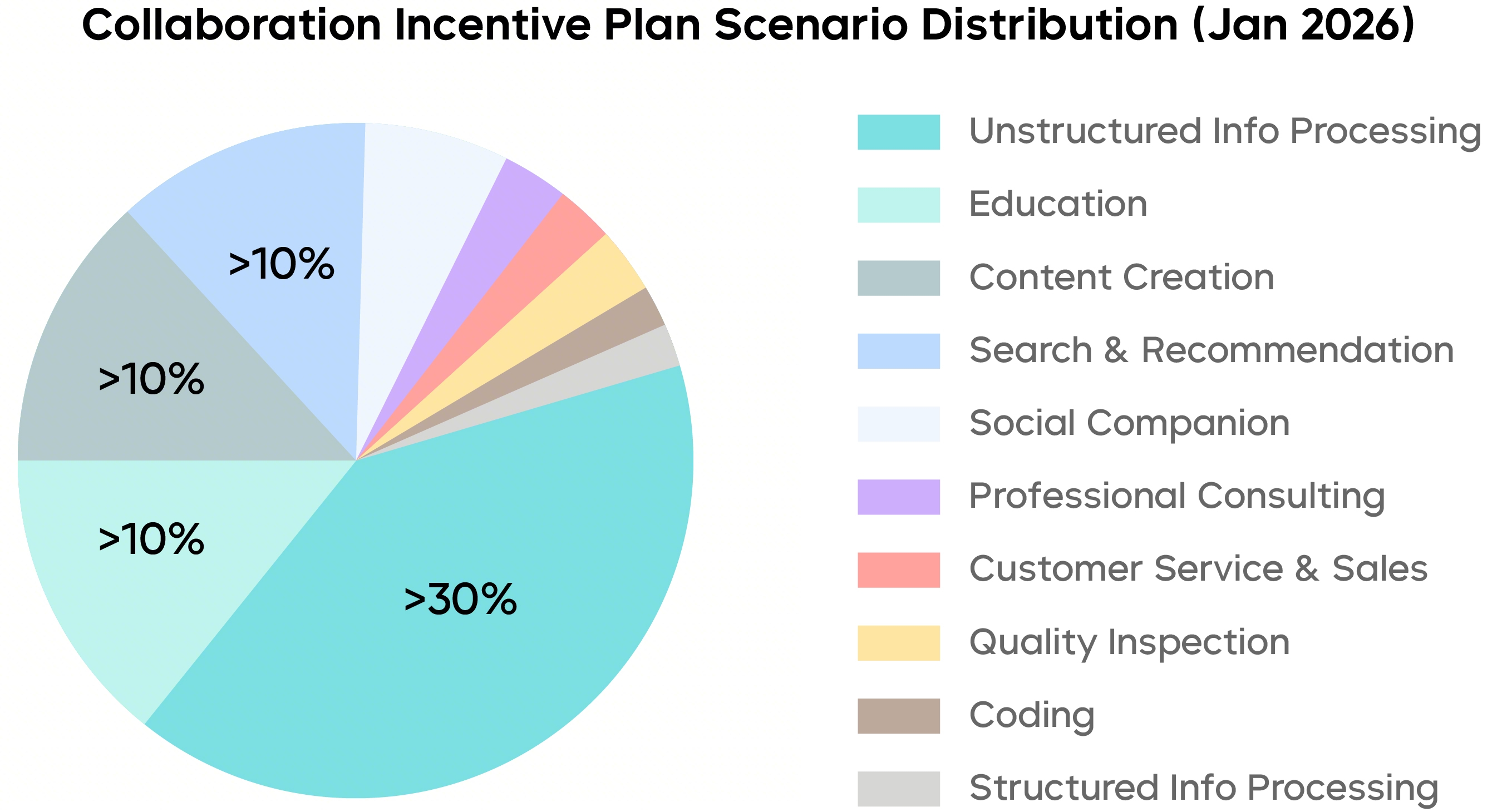
The official chart below also reflects where current enterprise demand is concentrated:
2) Real gains in multimodal and long-context tasks
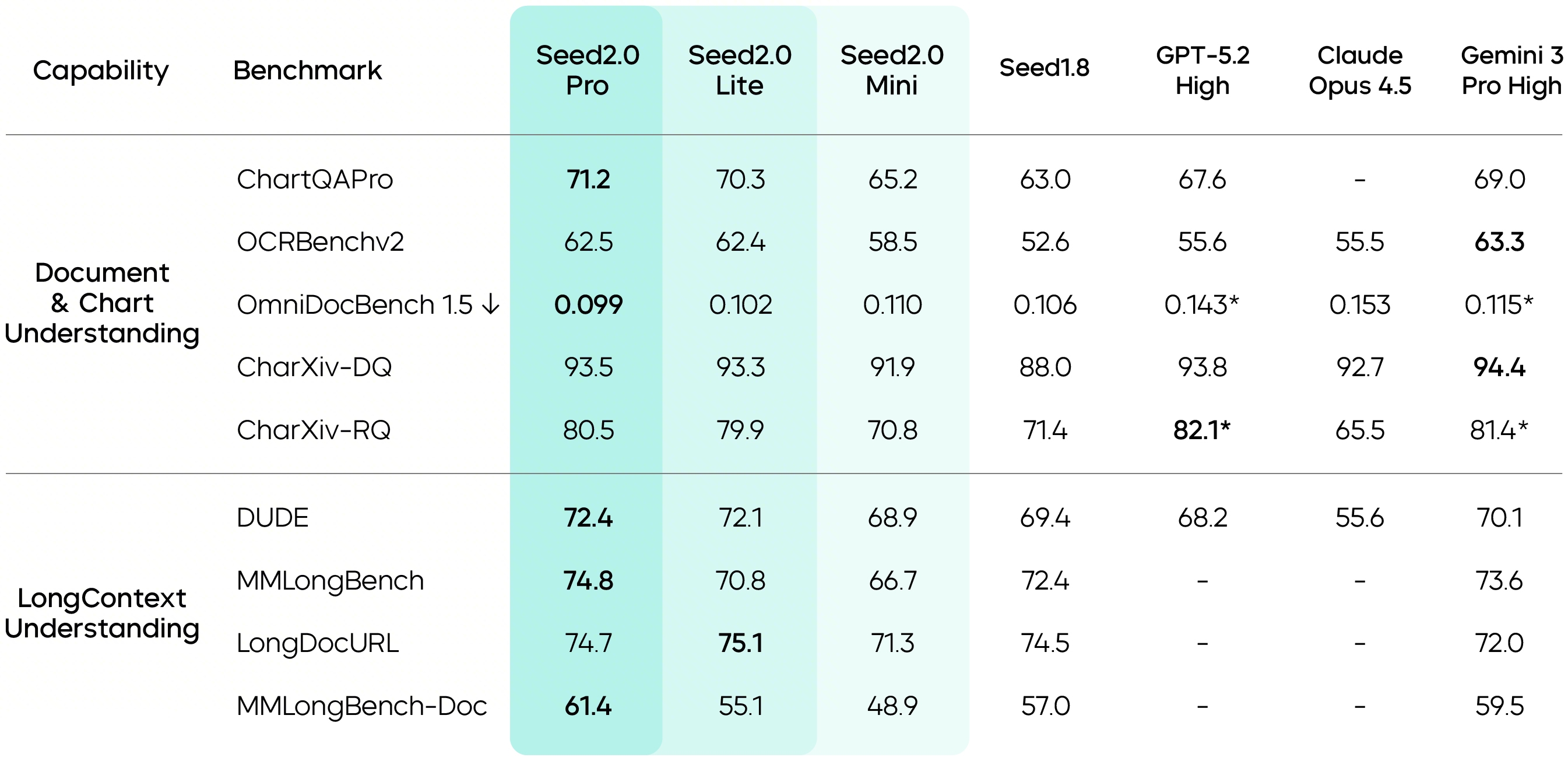
Public tables show visible improvements for Seed2.0 Pro in visual understanding, document tasks, and long-context benchmarks.
Benchmarks like DUDE and MMLongBench are less about simple image QA and more about stable reasoning under long inputs.
3) Stronger Agent direction, especially in video and search/research chains
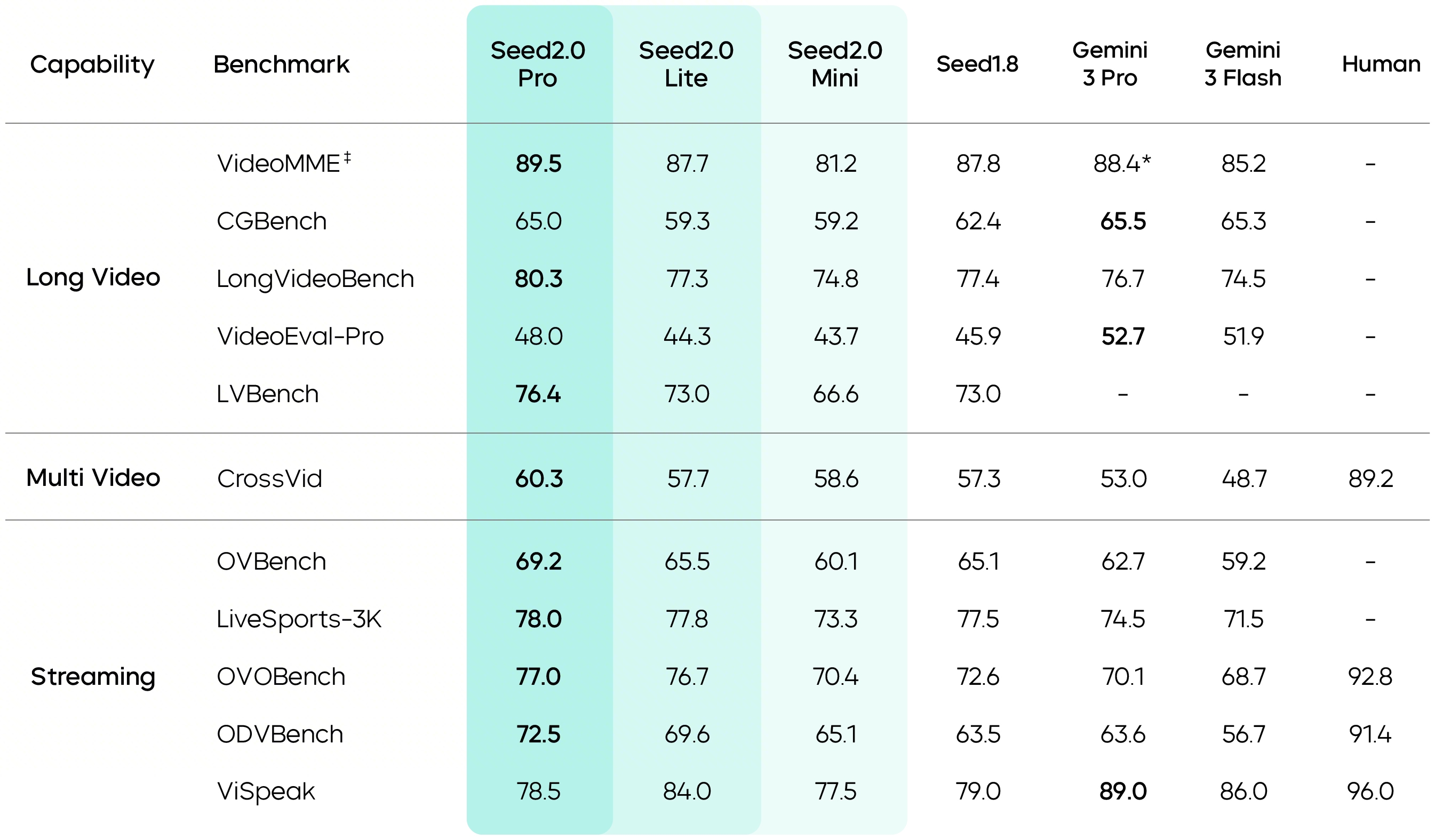
This release is not only about text agents.
Video reasoning, long-video understanding, multi-video tasks, and streaming benchmarks are all part of the matrix, with explicit emphasis on tool coordination (for example, VideoCut).
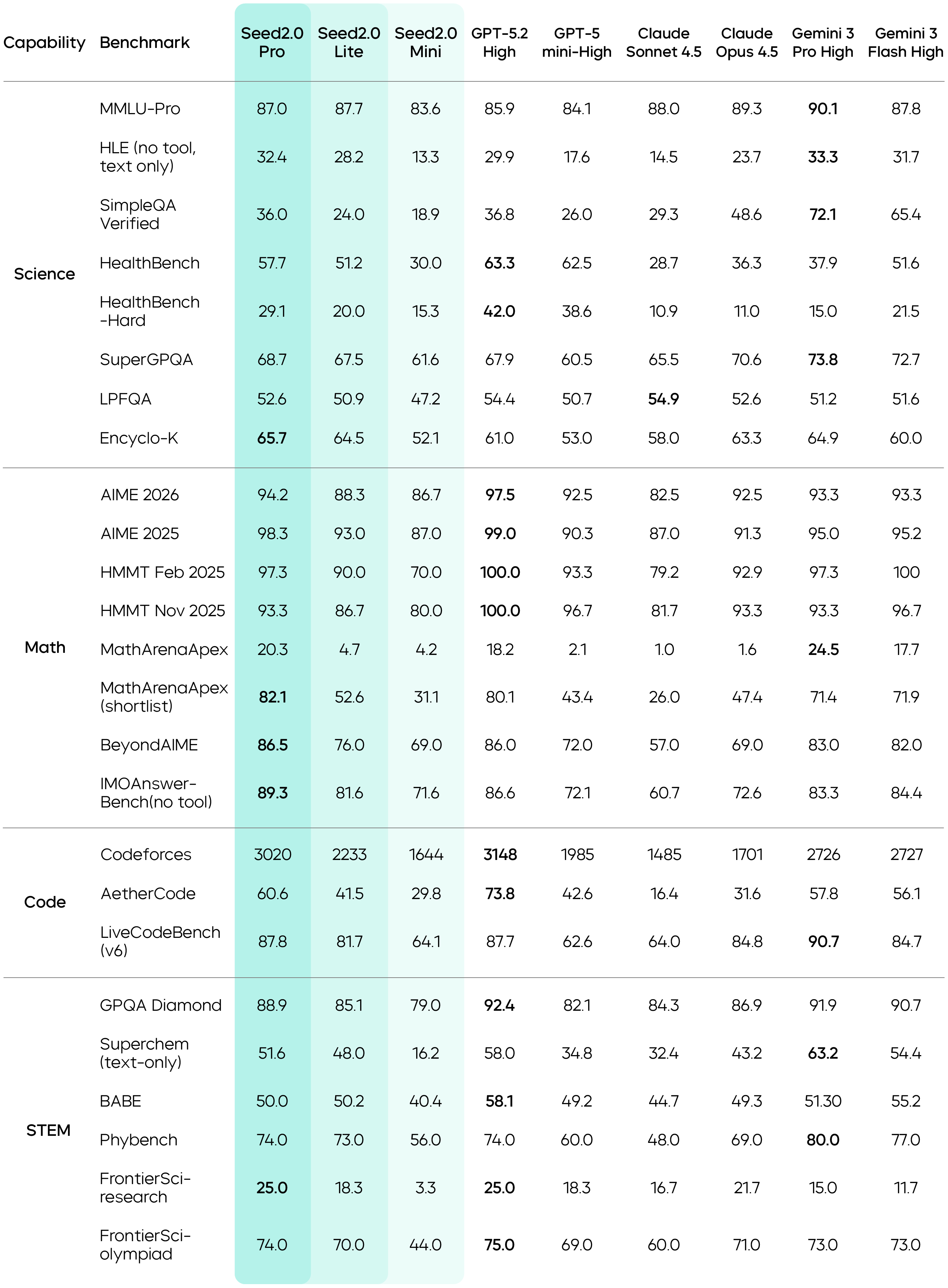
The consolidated capability table also suggests Seed2.0 is now consistently in the front tier across math, code, and science tasks:
Cost and Access Are Clearer This Time
Two pricing views are especially useful:
- Model Card representative pricing per 1M tokens:
Proinput $0.47 / output $2.37, Liteinput $0.09 / output $0.53, Miniinput $0.03 / output $0.31. - Volcengine documentation with context-tier pricing and cache-related cost items.
The practical value is that cost is now easier to model, not just easier to market.
Usage Experience
From this round of hands-on usage, three changes stood out:
- Better stability on long prompts, with fewer off-track responses.
- More consistent structured outputs in multi-step tasks.
- Stronger practical value for the Code model when used inside tooling workflows such as TRAE.
Who This Fits / Who It Does Not
Better fit:
- Teams actively working on model routing and cost optimization.
- Projects already moving beyond a single-model setup.
- Workloads that combine multimodal input with agent workflows.
Less fit for now:
- Decision processes that rely only on one benchmark leaderboard.
- Teams without stable task samples for a minimal evaluation loop.
Primary Sources
- Seed2.0 official release (2026-02-14)
https://seed.bytedance.com/zh/blog/seed2-0-%E6%AD%A3%E5%BC%8F%E5%8F%91%E5%B8%83 - Seed2.0 project page
https://seed.bytedance.com/zh/seed2 - Seed2.0 Model Card (official PDF)
https://lf3-static.bytednsdoc.com/obj/eden-cn/lapzild-tss/ljhwZthlaukjlkulzlp/seed2/0214/Seed2.0%20Model%20Card.pdf - Volcengine pricing doc (
doubao-seed-2.0-*)
https://www.volcengine.com/docs/84458/2123431 - Seedance 2.0 official release (date disambiguation)
https://seed.bytedance.com/zh/blog/seedance-2-0-%25E6%25AD%25A3%25E5%25BC%258F%25E5%258F%2591%25E5%25B8%2583
Final Note
My current view is that Seed2.0 looks more like a complete product surface than a standalone model update.
Capability progress is important, but this release is equally about packaging and deployment economics.
The next two things worth watching are long-horizon stability and real production cost variance.
Comments